All colleagues should be home from the Fall Meeting in Copenhagen, Denmark,
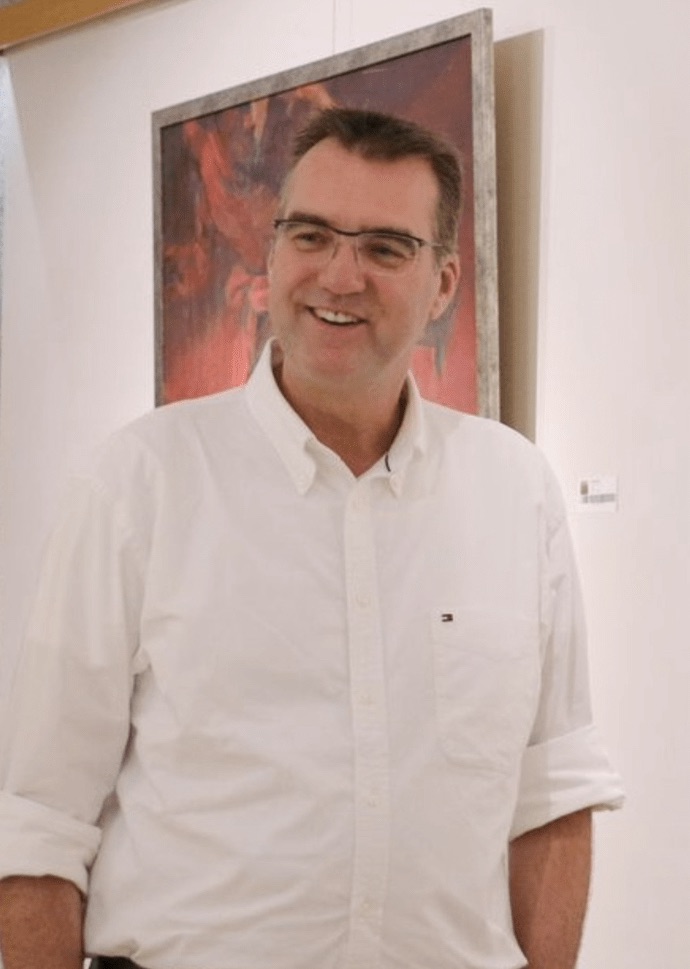
by now. I, Mats Olsson (MO), editor of ETENjournal, had the pleasure to have
an online interview Michel Hogenes (MH) of The Hague University of Applied
Sciences (THUAS), The Netherlands, right after the Fall Meeting. We are aiming
to publish more portraits of active ETEN colleagues here.

MO: Where do you come from, and what were your first international experiences?
MH: I was born and raised in Purmerend, a city just above Amsterdam. I studied in
Alkmaar, the well-known cheese city, also in the province of North-Holland. When I
met my partner, I moved to Zoetermeer, near the city of The Hague, both in South-
Holland. I had a wonderful childhood with my parents and younger sister. Our parents
stimulated us the do sports and make music. As we are from a working-class family,
my parents stimulated my sister and me to do the best we could at school to get
chances they didn’t have as children born in 1944 and 1945. As children and later
adolescents, we have never been abroad. We always went camping near the beach,
about 45 minutes from our house. I still have great memories of these holidays.
MO: How come that you’re an international coordinator now?
MH: It was when I met my partner Raimond when I discovered the joy of traveling.
His parents were – they already passed away – from what we call Indonesia
nowadays and had the leave the country after the war as they were Indo-Europeans.
Indonesian people, also looking Indonesian, however with mixed blood. Indonesia
has been colonized by the Dutch for about 350 years and became fully independent
in December 1949. It was incredibly difficult for them to leave the county and settle in
The Netherlands, even though they have always been formally Dutch. In 1996, we
made a trip with my in laws to Indonesia (father, mother, 4 children and their
partners). It was then that I fell in love with traveling and developed a special bond
with the Asian continent.
In the year 2000, I started working at the teacher education programme of The
Hague University of Applied Sciences. Right from the beginning, I got involved in
internationalisation.
In those days, the teacher education programme was after
European Studies and International Business the programme that sent out the most students for exchange/ studying abroad. Although the number of students who go
abroad is much less nowadays, the variety of activities we offer has been extended.
MO: Can you tell us more about these international activities?
MH: First, I should tell you that the programmes: Social Work, Pedagogy and Teacher
Education form the Faculty of Social Work and Education. Some activities are carried
out by the individual programmes. However, there are also activities in which we
operate as a faculty. I am currently the faculty coordinator internationalisation. The
three programmes each have their own programme coordinator internationalisation.
One of them you all know: my very dear and valued colleague Nora Daoud.
Traditionally, we focus on student exchange as main form of internationalisation.
When I started working at THUAS, one third of our third-year students went abroad.
Due to financial reasons less students like to go abroad. If students don’t finish their
study in four years, studying becomes (much) more expensive in the Netherlands.
Students therefor don’t take the risk to take longer to complete their studies. At the
moment about ten percent of the teacher education students go abroad. By the way,
most of them go to ETEN partners.
We also get inbound students for our international minor called ‘Educating Children in an Urban Environment’. This minor runs in the first 10 weeks of the academic year,
starting in September. Students that want to stay in The Hague for half a year
proceed with the 10-week pedagogy minor ‘Global Perspectives in Child Rearing and Family Support’.
Internationalisation is an intrinsic part of the THUAS DNA. As not all students have
the possibility to go abroad, ‘Internationalisation at Home’ has become more and
more important. Like we could have seen during the multiplier event ‘Uncoiled’ prior
to the Fall Meeting, Collaborative Online International Learning (COIL) offers
interesting possibilities for internationalisation at home. Students conduct joined
projects with students of other universities. In our faculty, we did COILs with
universities in Sweden, the Czech Republic, but also with South-Africa and the USA.
In the beginning, we mainly used COIL in the upper years of our programmes. We
now offer COILs in year one and two as students also become more interested in
internationalisation, and probably exchange/ studying abroad in year three, because
of COIL. Our Social Work programme also participates in so-called BIPs, Blended
Intensive Programmes. I like this Erasmus+ option in which COIL should be
combined with physical exchange. Not all students are able to leave home for three
or six months. However, one or two weeks is sometimes possible.
Another internationalisation option of our faculty is an international week in which
students can make a one-week trip to Copenhagen. Students that don’t want to or
cannot travel participate in workshops given by international organisation in our own region. Luckily, the city of The Hague has lots of non-governmental organisations
focussing on children, as well as international schools.
MO: What wishes do you have for the future?
MH: Last year, we made a cautious start with an international film festival in which
students could watch multicultural films on child rearing and education. The films
were introduced and/ or discussed by experts and students. We would like to have a
yearly programme with interesting older as well as new films. We also like to
increase our number of COILs, BIPs, as well as the number of students that like to go
on physical exchange. I don’t want to bore you with all other wishes we have.
MO: What is the added value of ETEN in this all?
MH: ETEN is a very important organisation for THUAS’ Faculty of Social Work and
Education. Like I said before, most of our teacher education students who go abroad
often go to ETEN partners. This also applies for some of our pedagogy students. In
ETEN, we get to know partners better, so it feels save to send students to colleagues
we know quite well. Through ETEN, we also get to know new partners. Furthermore,
ETEN inspires us to implement new content and work forms. It also often points at
new perspectives regarding topics that are presented in the Thematic Intertest
Groups, TIGs, at the Spring Conferences.
The Spring Conferences are a great hub for colleagues to present their work. The
TIGs feel like small very inclusive communities to me, so colleagues who never
presented abroad can present there, as well as colleagues with lots of experience.
There is always a nice blend of specialists and newcomers. Last but not least, ETEN
has its own scientific peer-reviewed journal, JETEN, the Journal of the European
Teacher Education Network. JETEN offers colleagues a great platform to publish
their work. Articles that are published in JETEN can also be found in the Directory of
Open Access Journals, DOAJ, so everyone can read your work. For non-scientific
publications ETEN has ETENjournal.
MO: You are the editor of JETEN and since last year a board member. When did you
get involved with ETEN?
MH: My first Spring Conference was in 2005 when we gathered in Macedonia. This
was also the conference where the Arts Education TIG was founded by Peter
Gregory. Although it was minus 20 degrees Celsius outside, the atmosphere of the
conference was fabulous. From that year on, I attended most of the Spring
Conferences. I have been TIG leader of the Arts Education TIG for over ten years. I
was substitute TIG leader of the Internationalisation TIG in 2023. I like my role as
editor of the journal, and I am proud that I was elected last year as board member.
I really hope to be member of this professional community for a long time.

Although we just had our September Meeting, I am already looking forward to meeting the
colleagues at the Spring Conference at PXL in Hasselt, Belgium. I am 100% sure that
the PXL team, led by Anniek Orye, and supported by the ETEN board, and the ETEN secretary Annette Bruun, will organize a fabulous conference. See you in Hasselt!
Categories: Arts Education, Portraits
 ETEN Journal
Leave a comment