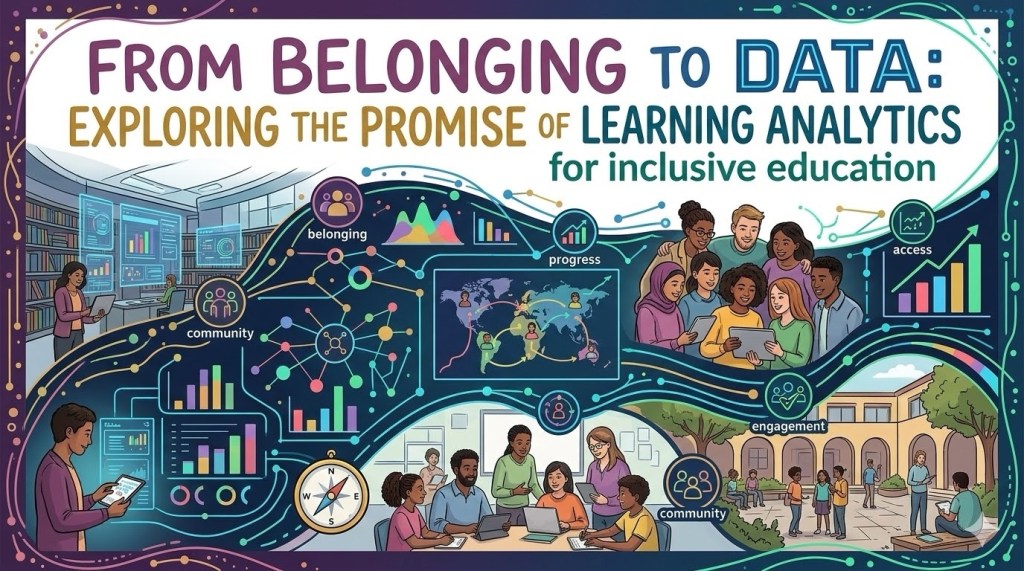
Last year, the reflections in my columns for ETENjournal were centred around themes like belonging in education, neurodiversity in the classroom, and the empowerment of children and young people. All these topics share a common concern: How can we create educational environments in which all learners really have the opportunity to participate, develop and flourish?
This week, I started a new professional chapter. I joined the research group ‘Learning Technology & Analytics’ at the university where I already work, The Hague University of Applied Sciences. This start feels both exiting and slightly unfamiliar. My background lies primarily in pedagogy, inclusive education, and performing arts. Learning analytics, machine learning, and educational data science belong to a different – and rapidly evolving – domain of educational research and practice.
The more I explore this field, the more I begin to see connections with questions that have occupied colleagues and myself for decades. In the inaugural lecture of this research group’s leader, Prof. Theo Bakker, the central issue is captured in a powerful phrase: ‘No fairness without awareness.’ Learning analytics aims to analyse educational data in order to understand patterns in student participation, study progress, and outcomes. When used in a responsible way, such analysis can help to identify inequalities that may otherwise remain invisible. Data can reveal for example which groups of students and pupils experience higher dropout rates, which learning pathways are most successful, and where structural barriers may exist in educational systems.
For those of us who are committed to inclusive education, this opens new and interesting perspectives. Traditionally, discussions on inclusion have heavily relied on qualitative data: experiences in classrooms, stories of teachers, or case studies of individual pupils. These perspectives remain essential. However, data driven approaches may complement them by revealing patterns in a systematic way. Learning analytics can give insights in ways in which institutional structures support (or hinder) equal participation.
At the same time, these technological developments raise important questions. Algorithms and data are not neutral. Educational data sets often reflect historical inequalities, and predictive models may unintentionally reproduce existing biases. Researchers working with learning analytics therefore emphasise the need to analyse fairness within educational data and machine-learning models to ensure that technologies do not reinforce the very inequalities they aim to address.
Artificial intelligence and adaptive technologies are already being explored as tools to support inclusive learning environments. Recent studies suggest that AI-driven systems can personalise learning pathways, support students with disabilities via assertive technologies, and give real-time feedback that is tailored to individual needs. In theory, such technologies could help educators respond more effectively to the diversity of learners in their classrooms.
However, theory alone is not enough. As teacher educators, we must make sure that technological innovation remains grounded in pedagogical values. Inclusive education ultimately about human relationships, trust, and participation. Technology should support these goals rather than replace them. Learning analytics can help us understand learning processes more clearly, but it cannot replace the professional judgement and ethical responsibility of educators.
For me personally, entering the world of learning technology and analytics therefore feels less like leaving my previous work and more like an expansion of it. Questions about belonging, empowerment, and inclusion remain central. What changes are the tools we use to explore these questions.
Maybe, the most important challenge for the coming years will be building bridges between fields that have often developed apart from each other: pedagogy, data science, educational technology, and teacher education. If we succeed in doing so, learning analytics may help us to develop a richer understanding of how inclusive education can be realised more effectively. And who knows …. the next step in creating classrooms of belonging may not only begin with listening to students’ voices, but also with learning how to read the stories hidden within educational data.
Michel Hogenes, March 2026
The Hague University of Applied Sciences
 ETEN Journal
Dear Michel,
For approximately three semesters, I have been integrating the use of artificial intelligence into my lecture on personal development planning for children. Within this course, we critically examine both the potential benefits and the risks associated with the use of AI in this field.
One important insight gained by the students concerns the central role of systematic preliminary observation and data collection. They recognize that high-quality, well-structured information is essential for formulating precise prompts that allow AI systems to generate meaningful and context-sensitive development plans. At the same time, when sufficient and appropriate information is available, the classification and analytical structuring based on the International Classification of Functioning, Disability and Health for Children and Youth (ICF-CY) can be supported by AI. In our experience so far, AI-assisted structuring and preliminary evaluation within this framework has produced remarkably consistent and useful results.
In Vienna, we are currently aiming to expand the research focus on this topic within the field of inclusive pedagogy. Our intention is to explore how ethical considerations, pedagogical principles, and technological possibilities can be systematically addressed and integrated.
In this context, I will also present a paper at the IASSIDD World Congress 2026 in Munich at the end of July. The presentation is entitled: “AI-supported development planning for students with intellectual and developmental disabilities: Potentials, challenges, and empirical evidence.”
Kind regards,Thomas
LikeLike
Answer from Michel (through Mats)
Dear Thomas,
Thank you very much for your response to my column. I found your description of the inclusion of integrating artificial intelligence into your course on personal development planning for children both interesting and highly relevant.
The approach you describe, combining systematic observation and data collection with AI-supported structuring within the ICF-CY framework, seems to be a promising direction to me. In the literature I read, the potential of AI for supporting educational planning and analysis is frequently highlighted. However, concrete and carefully reflected classroom applications such as the one you describe are still – as far as I am aware of – relatively rare. Your experiences therefore form an important bridge between theoretical possibilities and pedagogical practice. At the same time, as you note, the ethical and pedagogical implications require careful consideration. Especially when working within the field of inclusive education.
I would be very interested in reading your paper for the IASSIDD World Congress once it is ready. The topic you propose addresses precisely the type of questions that many teacher educators and researchers are currently grappling with.
May I also encourage you to consider writing a contribution on this topic for ETENjournal? I believe many colleagues within the European Teacher Education Network would greatly benefit from learning more about your experiences and research in this area. Whether in the form of a short reflective piece or a more extensive article; it would be a valuable addition to the ongoing conversation about the role of AI in inclusive education.
I look forward to hearing more about your work and wish you a lot of success with your presentation in Munich.
Kind regards,
Michel
Dr. M. (Michel) Hogenes
Faculteit Sociaal Werk en Educatie
LikeLike