
The board recieved a letter from Neil Hall and we’re happy to publish this part of the ETEN history here.
Dear ETEN Board
A couple of weeks ago I was surfing the web and thought that I might explore what publications of mine come up: not a lot unless you search more specifically than just my name. This led to my searching both international and Australian databases, and then I came to ETEN’s website.
Prior to the Covid pandemic I had been communicating with Mats Olsson and I sent him electronic versions of many early ETEN publications that I had edited, mostly with Doug Springate: Mats loaded the publications onto the ETEN website. The pandemic together with some personal matters interrupted my communications with Mats, and I still have an electronic copy of JETEN 3 to send him. At the time Mats said that he was interested in writing up something of the history of ETEN: and there it was (Link) not written by him but by a number of contributors.
Doug and I get a mention under the early publications via the University of Greenwich but I thought that it was worth giving some detail which will be lost unless I write about it. So here it is …
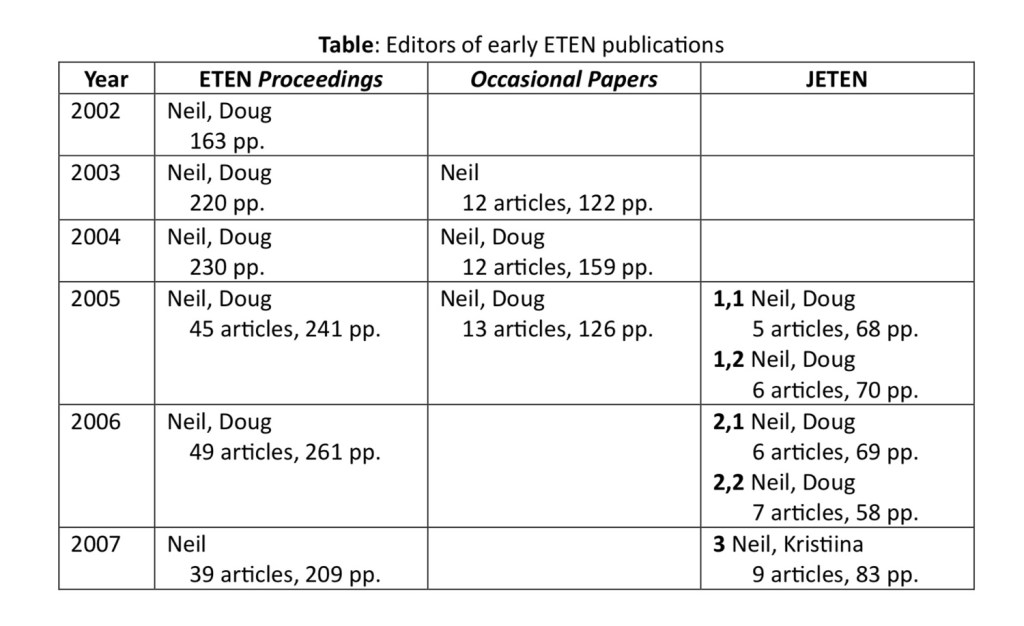
The information in the Table shows that 14 ETEN publications were produced by the School of Education and Training at the University of Greenwich from 2002 to 2007. The editorial board for much of this time was Neil, Doug, Kristiina and Jay and we were assisted by a team of reviewers who changed from year to year. Many of the articles in the Occasional Papers, and to a lesser extent in JETEN were written by authors for whom English was their second or third language. Doug and I re- wrote portions of many papers doing our best to ensure the original meaning was maintained. The following words were included in the editorial of JETEN 1(1):
In accepting articles for this journal we are prepared to support those for whom writing in English is problematic, by editing their work and by accepting some nuances of language that may not be part of everyday speech, but which give a more authentic voice to the author.
As editors we aim to provide a voice for cultures where language, history or politics have made it problematic for the representation of views and practices to a broader readership.
In the guidelines for authors at the back of the journal we wrote:
Manuscripts will be read by one of the editors, and if considered suitable for publication will be passed on to one other member of the ETEN editorial board and to an additional member of the editorial panel. Three referees have to agree before a paper will be accepted for publication.
So JETEN was internationally refereed from the start. Here’s how all this came about:
I joined the University of Greenwich in August 2000, as the Director of Research in the School of Education and Training, with two roles: to increase research and publication by the School and to develop a taught doctoral program: a Doctorate in Education (EdD). I talked a lot with Doug when ETEN held its 2002 meeting at Greenwich. Here was an opportunity for staff at Greenwich to present scholarly papers, and an opportunity for ETEN to record the history of their annual meetings and to encourage scholarship, publication and dissemination. Doug was essential in moving this idea along because he had a long history with ETEN and was highly regarded. He convinced the Board to allow us to produce the Proceedings, and from this choose the best papers for the Occasional Papers. Because ETEN had not held meetings every year since 1988 we made a guess and called the 2002 meeting the 12th.
I attended the ETEN annual meeting in Groningen and encouraged staff from the University of Greenwich to present a paper. In Groningen many people came up to me and were excited either to have been included in a 2002 ETEN publication or were looking forward to being included in a 2003 publication. ETEN Proceedings included all conference papers submitted to the editors but not all TIGs supported this. The Occasional Papers were a refereed selection of papers from the Proceedings, refereed by the editorial board and other volunteers. I’m confident that Doug and I moved ETEN forward with these publications. JETEN 1(1) included these words in the guidelines for authors:
More than forty papers are generally presented at ETEN conferences, and a multistage reviewing process involving three or four referees reduces this number. Authors of the chosen papers are invited to submit edited manuscripts to the ETEN journal for possible publication.
I remember going to Oxford in 2004 to talk to the Board about the possibility of turning the Occasional Papers into a journal from 2005. Carl was there along with Jean Clarkson, Kristiina, Astrid and Helle. We talked about the process of creating the journal and how it would be funded. Doug and I went ahead and edited JETEN in 2005 and 2006 with the support of the ETEN Board: we are the founding editors of the journal. By the time of the meeting in Porto the Board knew that Doug had done his last editing for ETEN in 2006, and that I was moving that way. I edited the 2007 Porto Proceedings by myself and Kristiina and I edited JETEN 3.
In JETEN 1(2) I wrote in the editorial:
JETEN abhors narrow views and the diminution of professional independence and academic freedom. JETEN is about critical reflection of professional practice: about undue deference to authority and about questioning unevidenced claims. JETEN is about intellectual engagement in discussions relevant to an international audience of professional practitioners and researchers in education, training, social education and allied fields.
And in JETEN 2(2)
We may be thought of as romantics, but this desire for improvement through teaching, research, publication, advocacy, innovation and change exists for many members of the profession. ETEN and JETEN provide a means of engaging in these advanced professional practices. Typically we have rejected the pursuit of wealth, we have preferred the social model over the business model.
Initiating the idea for ETEN publications and editing JETEN with Doug are a part of my career of which I am particularly proud. Doug was hugely committed to ETEN and each of its parts, TIGs, student and staff exchanges and shared projects. My commitment was more to do with creating publications for ETEN, to raise scholarship and to support dissemination.
Congratulations to ETEN for continuing to be a vibrant organisation and for successfully managing JETEN over many years.
Neil Hall Neilhall2@hotmail.co.uk

Read Doug Springates respons.
Categories: Articles - JETEN, The history of ETEN
 ETEN Journal
Very important part of ETEN’s history. Thank you.
LikeLike
Thank you for sharing this part of the history of ETEN Neil! You and Doug have done mountains of work! I remember the ETEN conference at Greenwich and our meeting in Oxford very well. What happened then still forms the basis of ETEN today.
Astrid
LikeLike
I am delighted I was involved in the evolution of ETEN. It served to develop an educational philosophy that influenced schools in both Europe and the US.
Thank you.
LikeLike
Thank you for sharing this incredible piece of history, Neil! As an educator from Argentina, I find it deeply inspiring to see the dedication and passion that have gone into creating and nurturing such a significant platform for professional growth and intellectual engagement. The legacy of ETEN and JETEN speaks volumes about the power of education to connect people and ideas across borders.
In the spirit of continuing this tradition of knowledge-sharing and innovation, I wanted to mention that I’ve developed a course titled “ChatGPT Education” on Udemy. This course is designed to help educators integrate AI tools like ChatGPT into their teaching strategies, offering new ways to engage students and enhance learning outcomes. Together, we can keep pushing the boundaries of education and create new opportunities for growth in the digital age.
Keep up the incredible work, and let’s continue empowering educators worldwide!
LikeLike